Promotion of Climate-Friendly Cooking: Kenya and Senegal
Improved cooking technologies help protect the climate by reducing carbon emissions and contributing to reaching Kenya’s and Senegal’s Nationally Determined Contribution (NDC) targets.
Technologies used in this project
- Improved cookstoves
Country data
-
Implemented in partnership with the EnDev programme as an associated project
- 5,949,437 improved cookstoves (ICS) have been sold
- 5,711,639 tCO₂e greenhouse gas emissions reduced by project completion in 2025
- 23,678,289 individuals with improved access to low-emission energy sources (11,960,559 of these are women)
- 3,466 jobs created in the ICS value chain in 2025 (2,315 of these women)
Background
Around 15 percent of the global demand for energy is covered by traditional biomass such as firewood, charcoal, or plant residues. Before 2020, 2.8 billion people worldwide used this type of fuels for their daily cooking. This is also very common in both Kenya and Senegal. In Kenya, more than 80 per cent of the population used biomass fuels for cooking and heating; in Senegal, 58 per cent of the urban population and 86 per cent of the rural population (as per 2020).
Approach
The “Promotion of Climate-Friendly Cooking: Kenya and Senegal” project contributed to reducing Green House Gas (GHG) emissions and improving people’s – and especially women’s – living conditions by transforming the improved cookstoves (ICS) markets in both countries, to achieve a sustainable long-term market growth. This was done by addressing key barriers and using a holistic market-based approach. Through this, the project also supported the Government of Kenya and Senegal in realizing their potential of emission reduction for reaching their energy sector specific NDC targets until 2030.
The project followed a two-sided approach by focusing on improving the supply and demand side of ICS production in Kenya and Senegal. In order to strengthen the supply side, the project supported ICS producers to professionalise their production via tools, machinery, enhancement of production processes, as well as business development support to enable them to scale up their production, increase the quality of their ICS and thus become professional or businesses class ICS producers. Demand side interventions comprised of awareness creation and behavioural change campaigns, with nationwide outreach via TV as well as radio advertisement in addition to local individual events comprising of i.e., cooking demonstrations organised by women’s groups. These demand side activities focused on highlighting the livlihood, economic, as well as environmental and safety benefits along with the health impacts of the ICS. This market-based approach was complemented by interventions which improve the enabling environment, such as ICS quality standards and regulations – national ICS quality label – strengthening of stove testing capacities in line with established standards, creation of new stove testing centres and capacity building of county governments to plan and include clean cooking interventions in their plans.
Learn more about EnDev’s work on clean cooking.Impact
The project ‘Promoting Clean Cooking in Senegal and Kenya’ has truly demonstrated a paradigm shift through the scaling up of improved cookstove use in Senegal.
Madeleine Diouf Sarr, Director of Climate Change, Ecological Transition and Green Finance, Ministry of Environment and Sustainable Development, Senegal
The paradigm shift was achieved by systematically removing market barriers and enabling exponential market growth. The project not only achieved its targets but exceeded them in several key areas, despite the setback due to the COVID-19 pandemic.
- A total of 23.68 million people gained access to modern energy solutions, more than doubling the original target.
- By 2025, the use of efficient stoves produced with support of the project had already resulted in a reduction of harmful climate emissions of 5.71 million tonnes of CO₂ equivalent. Over the full lifetime of the stoves, these reductions are expected to reach a total of 9.04 million tonnes.
- In Kenya and Senegal, strong progress in the cooking energy sector indicates that Nationally Determined Contributions (NDC) targets are on track: Kenya and Senegal are well positioned to exceed their national emissions reduction targets for the cooking energy sector by 2030.
- At the same time, 3,466 full-time jobs were created across the value chain for improved cookstoves.
- Through performance-based, targeted support, 156 improved cookstove enterprises in Kenya and Senegal were able to increase productivity. Investments, training, and business coaching enabled them to transition from artisanal production to professional companies and scale and invest in their operations.
As a result, the market share of professionalised enterprises now accounts for 95% of all sales in Kenya and 89% in Senegal. This demonstrates how targeted support can catalyse lasting market transformation and thus increase access rates to cleaner cooking solutions and reduce greenhouse gas emissions.
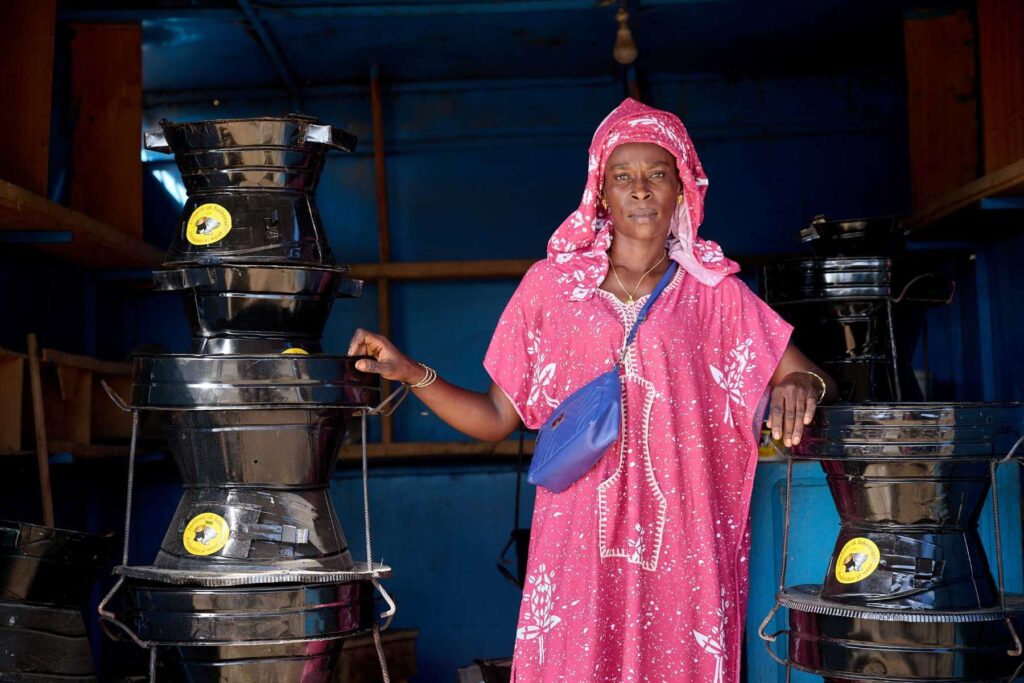
Clean cooking is no longer just a social cause—it is a strategic investment. The project has professionalised the value chain, creating a robust ecosystem where private capital and development finance now meet to drive a sustainable, investor-led future.
Dr. Faith Wandera, Director Renewable Energy, Ministry of Energy and Petroleum, Kenya
A Glimpse into the Lessons Learned
A key driver of this success was the programme’s professionalisation approach, designed to strengthen the capacity and competitiveness of local and national enterprises producing and selling climate-friendly cookstoves. Further lessons included:
- Professionalising Production: Tailored support strengthens the most capable stove producers into sustainable enterprises.
- Commercial Last-Mile Distribution: Supporting local distribution structures and groups (e.g., women’s or savings groups) expands household access.
- Ensuring Sustainability: Self-driven marketing and sales reduce dependence on external support.
- Robust Monitoring Systems: Digital MRV systems improve efficiency and data quality for NDC reporting.
- Integration into National NDC Systems: Household cooking data strengthen government planning and reporting.
Strong alliance of partners
The project was commissioned by the Federal Ministry for Economic Cooperation and Development (BMZ) and co-financed by the Green Climate Fund (GCF), the National Treasury of Kenya (National Designated Authority – NDA Kenya) and the Ministry of Energy and Petroleum of Kenya (MoEP), and in Senegal with the Ministry of Environment and Ecological Transition (METE, NDA Senegal) together with the Ministry of Energy, Petroleum and Mines (MEPM).
GIZ resumed the role of lead implementer and worked closely on country level with the so-called executing agencies and other implementing partners – in Senegal respectively the national non-governmental organisations CONCEPT, Enda Energie, and Enda Ecopop; in Kenya MoEP, Mercy Corps (including former Energy for Impact (E4I)), and Practical Action, supported by implementing partners: Strathmore University Energy Research Centre (SERC), Dedan Kimathi University of Technology (DeKUT), the Green Belt Movement (GBM), the Kenya Tea Development Agency Foundation (KTDA Foundation), and the Clean Cooking Association of Kenya (CCAK).
The project was implemented as an associated project to the Energising Development (EnDev) Programme under the umbrella of the EnDev Partnership. It is in line with the EnDev strategy 2019-2025 and thus EnDev’s’ overarching approach towards energy access for all.
Go to GCF project website for more insightsKnowledge Products
#1 Climate-friendly cooking: Scaling markets. A Guide on the Professionalisation Approach
This guide introduces the Professionalisation Approach by discussing preconditions, presenting key design elements, providing implementation advise and sharing early lessons learned. It is the first of three knowledge products planned, to be followed by a guide on how biomass cookstove projects can contribute to national NDC reporting and a Lessons learned report.
#2 Climate-friendly cooking: Demonstrating CO2 emissions reduction. A Guide on the Monitoring and NDC Reporting Approach
The report examines how improved cookstove projects can contribute to climate mitigation and to reporting on Nationalle Determined Contributions (NDCs).
#3 Climate-friendly cooking: A paradigm shift in Kenya and Senegal.
The lessons learned reports shows how climate-friendly cooking accelerates sector growth, transforms cooking markets and contributes to climate change mitigation.