How focusing on behaviour change leads to community-level shift to cleaner cooking
Villages across Cambodia are uniting to take collective action on harmful smoke and air pollution that has long filled their homes from cooking with firewood. Since 2020, EnDev, through its implementing partner SNV, has been championing the Smoke-Free Villages approach, a bold, community-driven initiative transforming the way people cook. At its heart, this remarkable approach uses community-based behaviour change communications, inspiring and empowering households to leave behind traditional firewood stoves for cleaner, healthier cooking solutions. By the end of 2024, 149 villages across Cambodia were proudly declared smoke-free, but what has made this approach so successful?
Creating agency to foster change
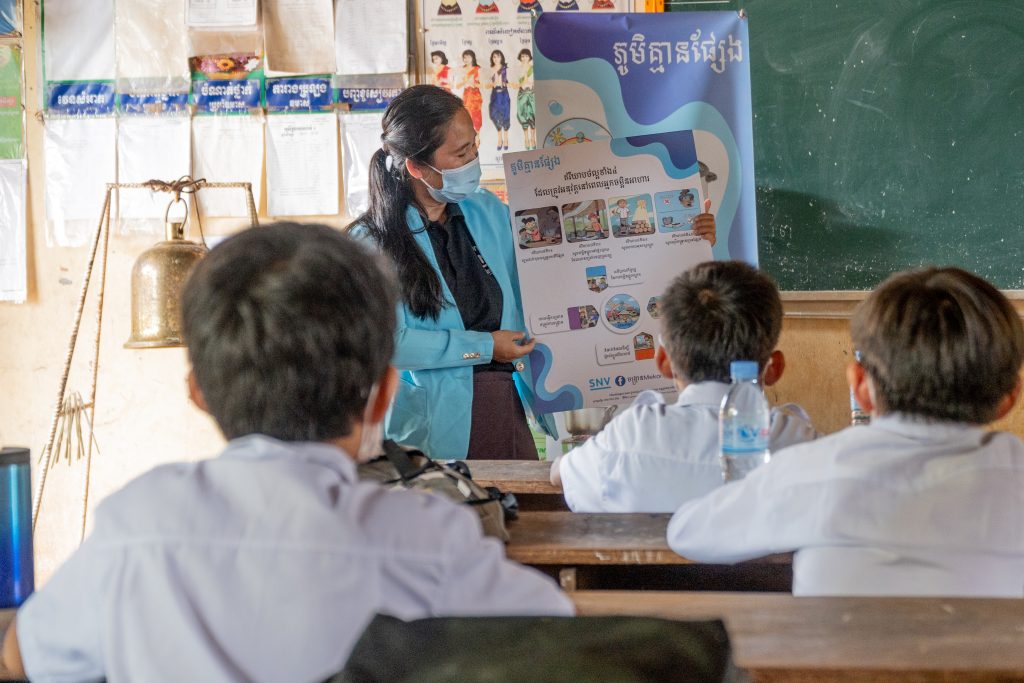
The Smoke-Free Village approach uses behaviour change communications to transition communities towards cleaner cooking practices. It focuses on awareness-raising events such as village meetings, school gatherings, door-to-door visits, and supplier cooking demonstrations, all organised by local authorities. Key stakeholders, such as teachers, monks, village health workers, and doctors, further spread the message. Rather than offering financial incentives to households or supply-side subsidies, this approach gives agency to households: it empowers them with the information they need to make their own decision on whether to switch to cleaner cooking solutions, in their own time.
By the end of 2024, 47 Commune Councils for Women and Children, covering a total of 457 villages in Cambodia, as well as 209 primary schools, 44 health centres, and 151 religious temples, were actively involved with the Smoke-Free Village approach.
“The Smoke-Free Villages approach is engaging everyone – men and women – through schools, religious centres, health centres. It’s a whole ecosystem”
Bastiaan Teune,
SNV Energy Sector Leader for Cambodia
Focusing on behaviour change
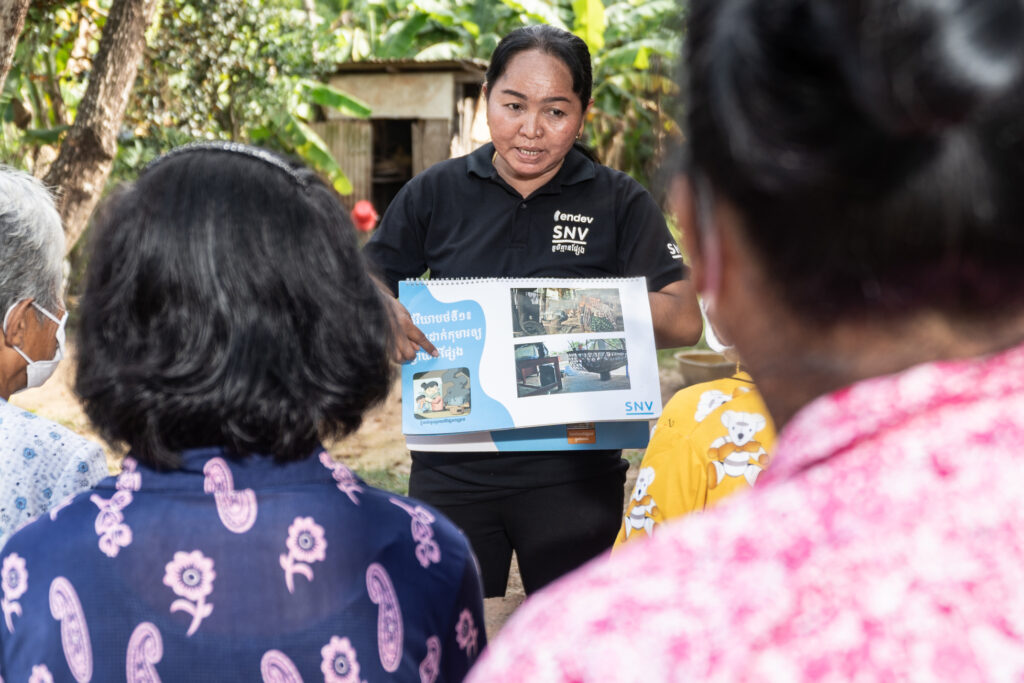
November 2021, Tuk Meas Khan Kal, Kampot Province (Cambodia) - SNV conducts a BCC village meeting with people from the commune, infomring them about the benefits of "clean cooking" andthe array of appliances they can have access to in order to live have healthier cooking. SNV staff use different methodology, such as roleplay and diffentent activities to sensibilize Commune members about adopting better cookinghabits
It is, however, a gradual journey from traditional firewood stoves to cleaner cooking, not an overnight switch – a survey undertaken by SNV in 2021 found most households needed at least 6 months to shift to cleaner cooking. To build up to this decision, there are four behaviour change communications activities in the Smoke-Free Villages approach. These activities promote four key cleaner cooking behaviours: keeping children away from smoke; cooking in a well-ventilated space; drying firewood; and investing in new, improved cookstoves and cleaner fuels. In 2023, 1,368 activities were organised, reaching almost 34,292 people. In 2024, the project almost doubled its outreach from 243 to 457 villages and 4,612 activities were organised reaching over 100,000 people. This led to a jump in the number of households using cleaner cookstoves as their primary stove from 43% in January 2022 to 64 % by the end of 2024.
The four behaviour change communications activities used in the Smoke-Free Village approach
Interactive village meetings form the cornerstone of the Smoke-Free Village approach. Participants play games like matching photographs together that depict different cooking environments or identifying their households on a map and colour-coding it with the type of cookstove they use. There are usually six meetings per village over one year.
The Smoke-Free Village Day activity is an annual event in each commune which takes place at the local school, involving 70–100 students and villagers, who paint murals reflecting on cleaner cooking practices to increase awareness among the children.
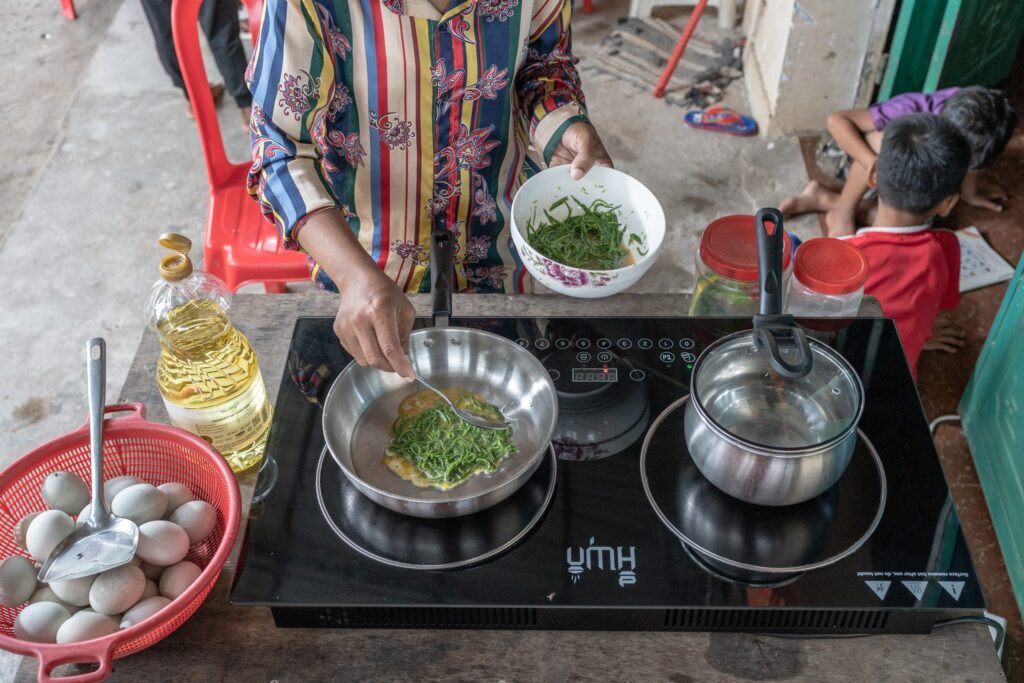
The Smoke-Free Village Cooking Fair takes place in the community to provide a cleaner cooking experience for 30–50 participants by using different types of fuels, and to evaluate costs and convenience.
Finally, monthly door-to-door visits to 15–20 different households in each village. Local authorities visit the households in person and present the behaviour change communications materials.
The behaviour change communications activities are reinforced through informative, visual materials. These materials are designed to be easy to understand; they clarify facts and dispel myths about traditional and smoke-free cooking through positive messaging. Households that do not see these educational materials tend to be more sceptical about changing the way they cook, and they often worry more about what clean cookstoves can’t do, rather than the impacts of smoke.
Providing evidence-based information, rather than incentives, creates a longer-term switch to cleaner cooking. Around 16% of people in Cambodia live in poverty, and at times it may seem like there might be a faster uptake or that it is more beneficial for households on tight budgets to receive subsidies or free cleaner cooking solutions, like electric kettles and cookers or gas stoves, to facilitate a change. However, as the SNV Energy Sector Leader for Cambodia, Bastiaan Teune said, “To be transformational, you cannot use subsidies as the main driver to change”. When products are given out for free or sold with subsidies, they are more likely to be sold off or forgotten about. What makes the Smoke-Free Villages approach successful is that it fosters a collaborative desire within a community to create a cultural shift in cooking norms. Households have the agency to make informed decisions and choices over which products they buy, and they are empowered by their choices. This means that when they decide to shift, cleaner cooking will continue well beyond EnDev support.
Motivators for change
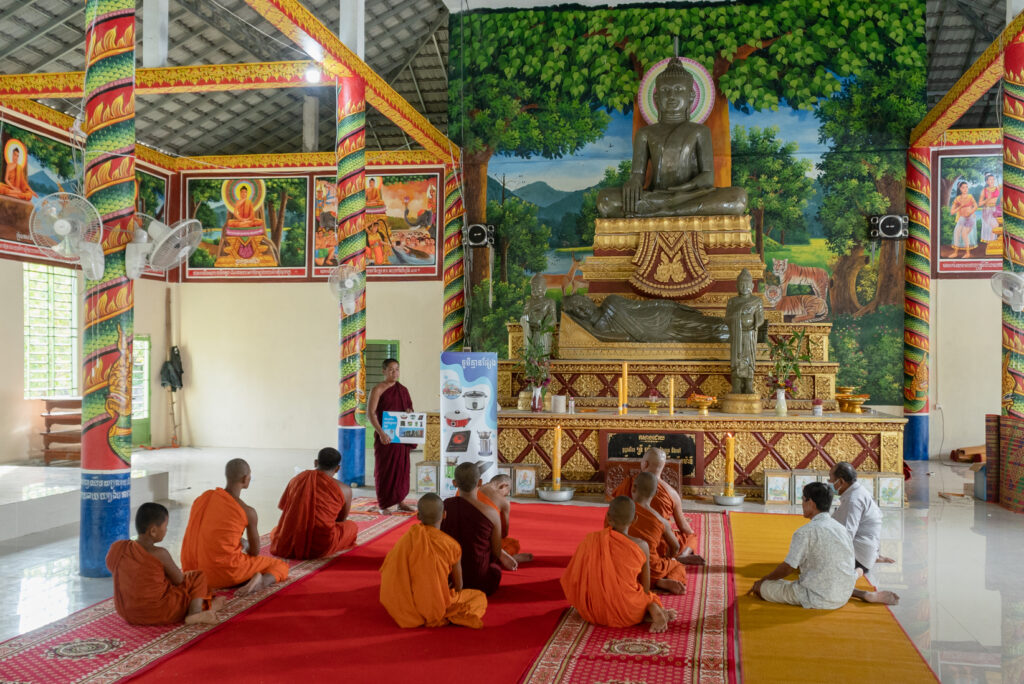
November 2021, Srae Khan Temple, Tuk Meas Khan Kal, Kampot Province (Cambodia) - A monk is conductiong a Trainer-to-Trainer session to fellow monks in the Pagoda. The monks will advocate for "clean cooking" habits to members of the commune.
One of the biggest drivers for households in Cambodia to switch from traditional stoves is the health benefits to them and their children: 88% of households surveyed in 2021 stated their biggest motivator was cooking without smoke and the associated health risks, compared to only 27% of households who said saving fuel or money was the main driver. Indoor pollution from fires can cause serious health problems and many diseases, contributing to over 15% of deaths in Cambodia each year.
As the Smoke-Free Villages approach also focuses on educating children in schools, it is possible to see how the drivers for young people may be different to their parents. Collecting wood, cleaning the pots, and tending the fire are tasks that disproportionately fall on young girls and women. Bastiaan Teune said, “I saw a mural in a school where there was a scary man behind a tree.” For girls, cooking with LPG or electricity eliminates the risk of needing to go into the woods to collect firewood. “It’s about feeling safe,” Bastiaan continued.
By the end of 2024, 149 villages in Cambodia were declared smoke-free, meaning that at least 85% of households use primarily cleaner cooking solutions. The approach has also been sparking change across Laos, Nepal, and Mali, a successful pilot was completed in Mozambique, and there are plans to develop the model in Bangladesh and Kenya. The Smoke-Free Villages initiative shows that with the right tools, messages, and motivation, entire villages can come together for real change.
Key lessons
Community-led action is crucial for success: the Smoke-Free Villages approach fosters a collaborative desire in a community to create a cultural shift in cooking norms.
By providing information through behaviour change communications, rather than relying on incentives, households have the agency to make informed choices and are empowered by their choices. This means that when they decide to shift to cleaner cooking, it will be a long-term, sustainable change.
Health is a very strong driver of change and more motivating than saving money or fuel.